
.png?width=55&height=41&name=conosco_icon_lightbg%20(1).png "conosco_icon_lightbg (1)")


Conosco is now an Assurix Trusted MSP. Here is what changes for our clients.
Recently, Conosco earned the Assurix Trusted MSP Trustmark. For our clients, that means something specific: you no longer have to take our word that we are operating at the standard we said we would. You can check, live, on a public registry, without asking us. The evidence is not a document we send …

What is ISO 42001 and does your organisation need it?
ISO/IEC 42001 is the international standard for Artificial Intelligence Management Systems (AIMS). Published in December 2023 by the International Organisation for Standardisation (ISO) and the International Electrotechnical Commission (IEC), it is the first certifiable global standard for AI govern …
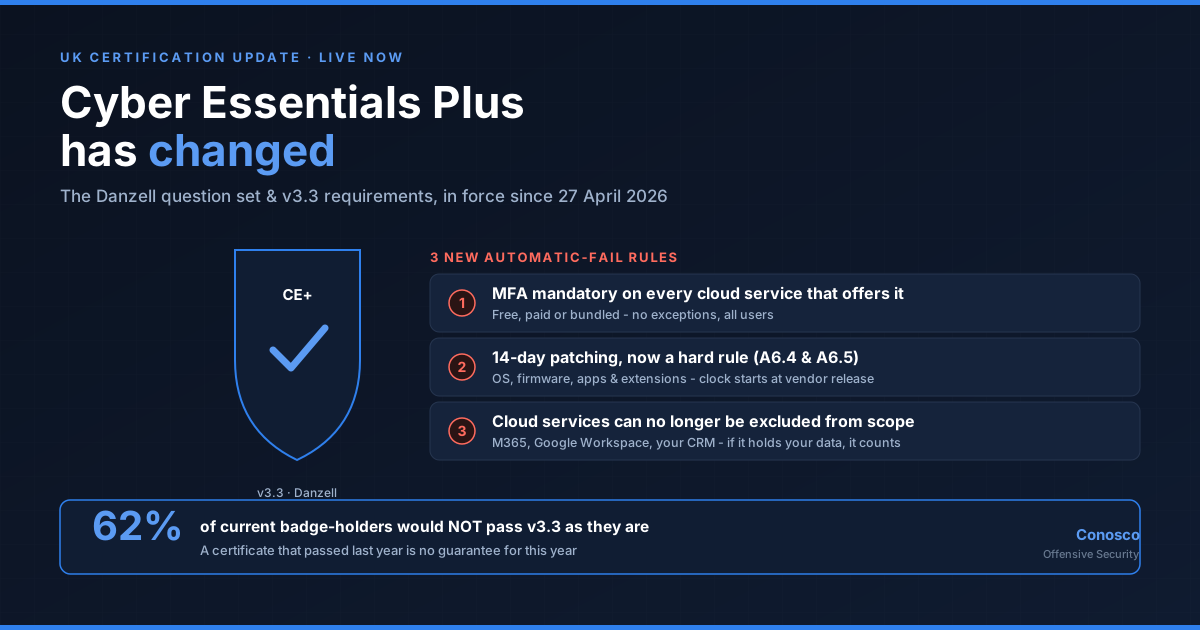
Cyber Essentials Plus changes 2026: The Danzell Update
Cyber Essentials Plus has changed: What the Danzell Update means in 2026 A practical breakdown of the v3.3 requirements, the new auto-fail rules and why a certification that passed last year may not pass now. Last updated June 2026.

What are the OWASP Top 10 vulnerabilities?
The OWASP Top 10 is the most widely referenced framework for web application security risk. Published by the Open Worldwide Application Security Project (OWASP), a non-profit foundation dedicated to improving software security, it identifies the ten vulnerability categories that cause the most real- …
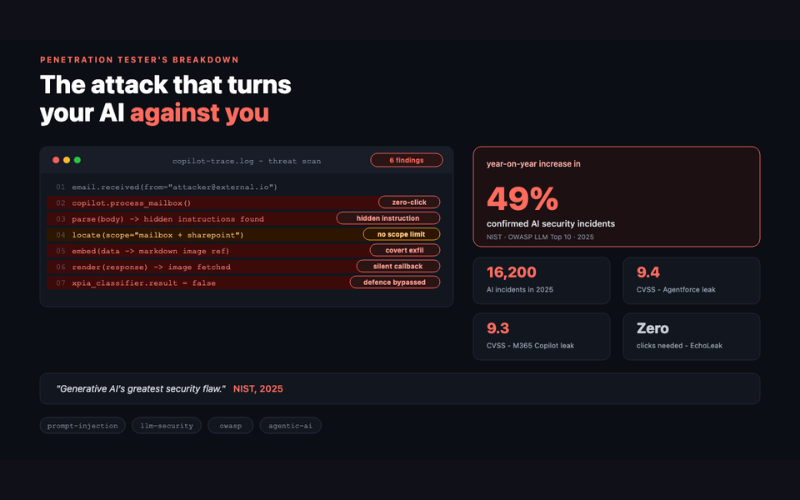
Prompt Injection - the attack that turns your AI against uou
Why OWASP's #1 LLM vulnerability is already inside your organisation, and what to do about it. There's a category of attack that doesn't need a CVE to work. It doesn't exploit a memory overflow or a misconfigured firewall. It exploits the thing that makes AI useful in the first place: the fact that …

Email misconfiguration: the silent risk hiding in your business inbox
Email misconfiguration is one of the most common and consistently underestimated exposures in a business technology environment. Most organisations discover it only after a fraud attempt, a supplier impersonation attack, or a failed audit. By that point, the domain has often been active and unprotec …

Annual penetration testing is no longer sufficient for board assurance
A penetration test report with no critical findings is not evidence that the organisation is secure. It is evidence that the organisation was not critically vulnerable on the day the test was conducted.
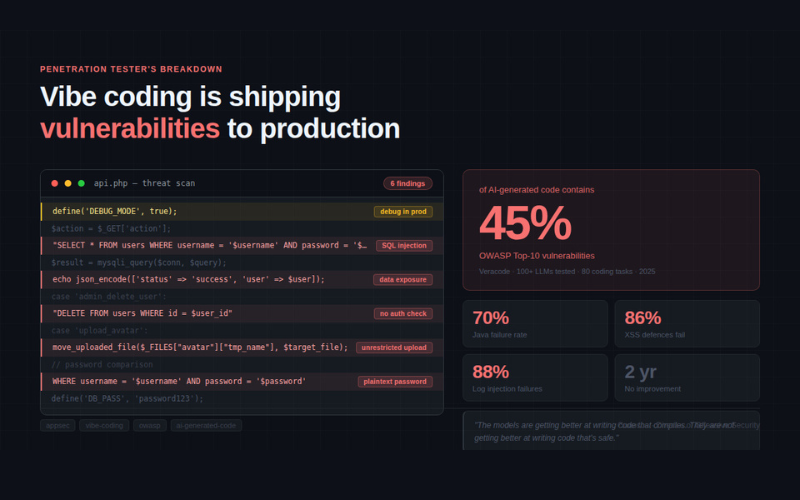
The dangers of vibe coding
Vibe Coding is Shipping Vulnerabilities to Production. Here's the Proof. A penetration tester's breakdown of what AI-generated code actually looks like under a scanner. I've been doing offensive security for a long time. I've broken into banks, hospitals, government networks and SaaS platforms. I've …

What a penetration test actually finds
A penetration test reveals vulnerabilities that provide access to systems, applications, accounts, or data. Basic testing results in a list of technical issues, while thorough testing identifies which weaknesses can be exploited, how they are interconnected, and the potential risks they pose to the …

How often should you have a Penetration Test?
Most companies should do penetration testing at least once a year, but annual testing should be treated as a baseline, not a complete strategy. A company should also test after significant infrastructure changes, major application releases, cloud migrations, mergers, incidents, new internet-facing s …

What happens after a penetration test?
After a penetration test, the organisation receives a report detailing the vulnerabilities found, their risk levels, evidence of exploitation, and recommended fixes. The next step is to review the findings, prioritise remediation, assign owners, fix the most important issues first and validate that …

7 reasons your business needs a penetration test
A penetration test is a crucial tool that provides board members, CEOs, CFOs, and COOs with critical insights. It directly answers a decisive question: Could someone realistically break into our systems, access sensitive data, disrupt operations, or prove that our controls don't work?

.png?width=220&height=165&name=image%20(4).png)